
The benefits of tracking SGX Nifty for international traders
Page Contents
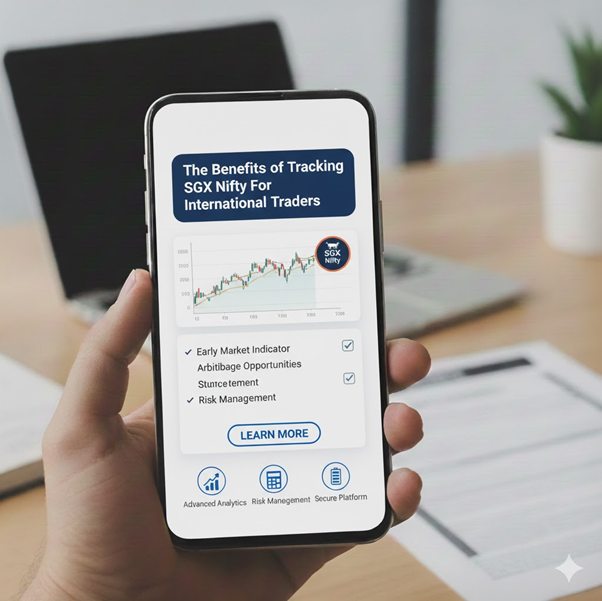
The Benefits of Tracking SGX Nifty for International Traders
If you’ve ever awoken, checked your portfolio, and asked yourself, “Why is everything red when the market isn’t even open yet,” it’s very likely the answer is SGX Nifty. Consider it the alarm clock for the Indian markets: it rings hours before the actual alarms start trading.
For international traders, SGX Nifty isn’t just a number flashing on a screen. It’s a real-time indicator of how the Indian stock market might behave when the bell rings at 9:15 a.m. IST. Whether you’re trading from London, Singapore, or Mumbai, keeping an eye on it gives you a massive head start.
And here’s the fun part: you don’t even have to trade in India to use SGX Nifty. You can simply track it to gauge market sentiment, predict movements, or plan global trades better. It’s like having a weather forecast for your trading day — without the guesswork.
What exactly is SGX Nifty?
Let’s simplify the terms without the complexities. SGX is the abbreviation for Singapore Exchange, while Nifty is the NSE Nifty 50 index of India- which measures how the largest and most traded stocks on the National Stock Exchange (NSE) perform.
Thus, SGX Nifty is simply the futures contract of the Nifty 50 available to be traded on the Singapore Exchange. It creates a way for investors outside of the country to trade or hedge their exposure to the Indian markets without being in the country.
In simpler terms:
- It closely replicates the Nifty 50 index.
- It makes any price moves while the Indian markets are closed.
- It’s the best pulse check for global investors tracking the economy of India.
Meaning, when you see the SGX Nifty shows +100 above the settled price for the day before the market opens, you already know the Indian markets may have an optimistic gap at the start of the day.
How SGX Nifty connects global and Indian markets
One of the most appealing features of the SGX Nifty is the timing of its trading. It trades prior to the Indian markets opening and continues after they close. For participants in intraday trading, this timing overlap offers an early glimpse into foreign investor sentiment toward macroeconomic factors related to India.
For traders operating across time zones, even a 20-minute window can translate into immense opportunity in intraday trading. That short period allows each trader to identify and strategically plan trades—rather than reacting after prices have already adjusted.
This can be viewed similarly to how global news impacts other sectors. Think about India. Think about ethanol stocks in India. If oil prices rise or global energy policies shift overnight, SGX Nifty levels may already reflect those developments before the Indian market opens. For intraday trading participants, this early signal can be valuable.
By the time foreign investors position themselves internationally, local traders are often interpreting movements influenced by currency fluctuations, oil prices, and global news.
Consequently, if you are involved in intraday trading or actively investing in energy-related sectors such as ethanol, monitoring SGX Nifty levels can serve as a reflection of broader sentiment and expectations before local markets fully react.
Why SGX Nifty matters for international traders
You may be thinking, “I don’t trade in India, so why do I care?”
Here is an explanation of why SGX Nifty still deserves a spot on your watchlist:
- It is an early indicator for Indian markets: SGX Nifty moves can give you insight into what to expect with how Nifty 50 may open. If you are trading any equities or derivatives on an international basis, it allows you to position yourself better across related portfolio segments.
- It connects sentiment abroad: SGX Nifty indicates how international investors feel about Indian markets. If foreign traders are bullish on India, you will see the SGX Nifty move up, even before domestic investors react to buying interest.
- It helps with risk management: For traders who do allocate to emerging market ETFs or indices that have exposure to India, SGX Nifty acts as a reliable hedging product. If you anticipate that India will open lower, you could take a position to offset that loss in your portfolio prior to Indian markets being open.
- It helps an investor learn the market: Even if you are a newer trader, following SGX Nifty helps you understand how markets abroad will impact the local markets. This follows through to how you sharpen your reading of market sentiment.
How to use SGX Nifty in your daily trading routine
Here’s some ways to incorporate SGX Nifty into your trading routine:
- Check it first thing: You should check SGX Nifty in the morning before Indian markets open. It will give you directional information about the markets, whether we could possibly open positive, negative or flat.
- Use it with global moves: Don’t use SGX Nifty in isolation, but compare it with movements of the US markets, European markets, and other markets in Asia. It will give you a more complete picture.
- Plan your entry and exits: It can help you set your trading tone for the day. If SGX Nifty is showing weakness, for example, you can set up defensive positions or tighten your stop losses.
- Intraday correlation: Even after markets are open, watch the opening hour, a lot of time it is a good representation of the sentiment of SGX Nifty. Pay attention to how closely the sentiment is correlated during the trading day, and you’d be surprised at times how closely they correlate.
Once you start to watch SGX Nifty consistently, you’ll start to see it almost whisper what the market might do once opened. You just have to pay attention.
What makes SGX Nifty unique
Unlike other indices, SGX Nifty is not geographically limited, and is accessible to traders unable to trade on Indian markets directly due to regulatory or logistical constraints.
What this means:
- A longer time window: You have insight well before and well after the Indian trading day.
- International participation: Very liquid, as international funds, institutions and traders take positions on this market.
- Transparency: The price moves in real-time with respect to the Indian market so you can interpret price moves prior to Indian trading hours.
- Flexibility: You can hedge or speculate on index moves without having to own Indian stocks.
It’s like taking a pulse on the market of India anywhere in the world.
How Indian traders can benefit too
Even if you’re sitting in Delhi or Pune, tracking SGX Nifty can make you a sharper trader. You’ll understand how global events — from oil price changes to foreign institutional flows — might affect your trades before the markets react.
Here’s how it helps you locally:
- You can prepare better for volatility. If SGX Nifty tanks overnight, you know what’s coming.
- You can manage intraday trades smarter. Early sentiment gives you a base for planning your strategy.
- You can spot global triggers early. Policy news, inflation data, or interest rate announcements often reflect in SGX Nifty before they hit Indian charts.
In short, it’s your pre-market compass.
The rise of global interest in Indian markets
India is now one of the fastest-growing economies in the world, and global investors know it. That’s why SGX Nifty has become such a popular tool — it’s a window into India’s financial future.
With major institutional money flowing into sectors like tech, finance, renewable energy, and ethanol-based industries, international traders are using SGX Nifty to track momentum shifts. When global funds change direction, it’s often visible here first.
So, whether you’re trading US tech stocks or energy companies in Europe, following SGX Nifty can give you an edge in understanding where the global money is flowing.
Common mistakes to avoid while tracking SGX Nifty
Before you dive into using it everyday here is some things you should not do:
- Don’t take it at face value: SGX Nifty will give you the direction of the market, not what is destined to happen. The Indian markets may still open up differently for local reasons.
- Do not trade on emotion: just because you see SGX Nifty was up or down 200 points, that does not give you permission to chase the first stock you see.
- Don’t forsake fundamentals: you will want to consider what SGX is showing, but you still will need to layer in the company’s performance and macro analysis.
- Don’t do it inconsistently: you will want to track SGX Nifty daily for patterns, looking at a random, single day will not represent anything worthwhile.
The consensus here is to treat this as a guide and not a decree.
Wrapping it up
SGX Nifty is more than just a pre-market indicator — it’s a bridge between global and Indian market sentiment. For international traders, it offers a quick snapshot of how investors view India’s growth story. For local traders, it’s an early-morning cheat sheet to prepare for the trading day ahead.
Whether you trade equities, futures, or even niche segments like ethanol stocks, keeping an eye on SGX Nifty helps you align your moves with the bigger picture. It’s that early pulse that tells you when to stay cautious, when to stay confident, and when to simply wait.