
CA vs CPA: Which is Smarter Choice for Finance Professionals
Page Contents
CA vs Certified Public Accountants: Which is Smarter Choice for Finance Professionals
When it comes to building a high-growth career in accounting & finance, two qualifications often top the list:
- CA (Chartered Accountant – India)
CPA (Certified Public Accountant – US)
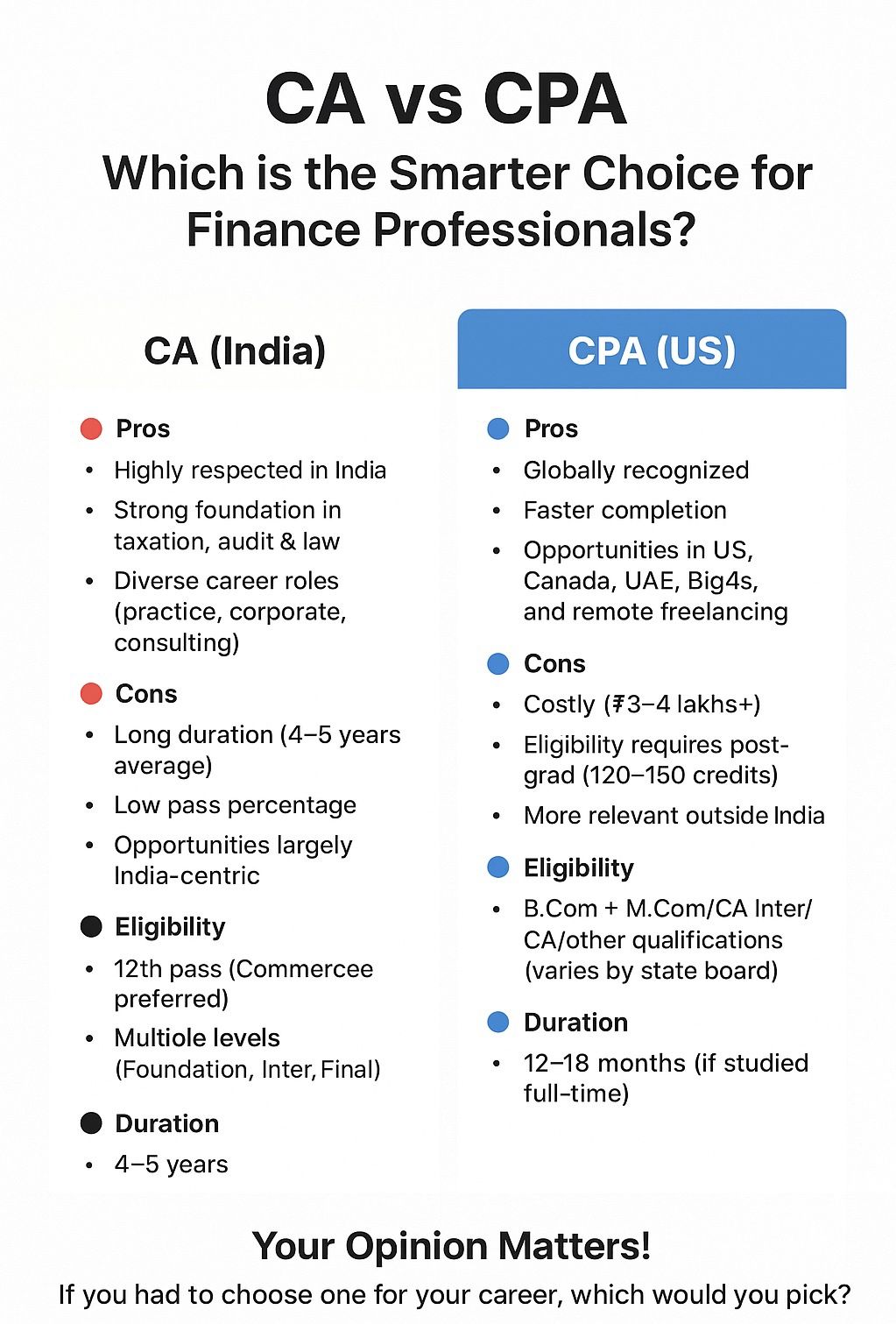
A side-by-side CA vs CPA comparison table (Duration, Cost, Eligibility, Recognition, Salary, Career Scope) right after the introduction would hook readers who prefer a visual summary before diving deep. Here’s a quick comparison to help you decide
Chartered Accountant (India)
Pros:
- Highly respected & recognized in India
- Strong foundation in taxation, audit & corporate law
- Diverse opportunities—practice, corporate, consulting
Cons:
- Long duration (avg. 4–5 years)
- Low pass percentage
- Career opportunities largely India-centric
- Eligibility: 12th pass (Commerce preferred) – Foundation → Inter → Final
Duration: 4–5 years on average
Certified Public Accountants (US)
Pros:
- Globally recognized credential
- Faster to complete (12–18 months)
- Opportunities in US, Canada, Middle East, Big 4s, remote freelancing
Cons:
- Higher cost (INR 3–4 lakhs+)
- Eligibility requires 120–150 credits (B.Com + M.Com / CA Inter / CA etc.)
- More relevant for careers outside India
- Eligibility: Varies by state board (generally B.Com + PG/CA equivalent)
Duration: 12–18 months (if studied full-time)
Correct Minor Inaccuracies
In the Program Completion Requirements, you wrote, “CPA has 3 exams”: Actually, the new CPA Evolution model (2024 onwards) has 3 core exams (FAR, AUD, REG) + 1 discipline (BAR/ISC/TCP), i.e., 4 sections total, not 3.
- CA practical training (articleship) is 3 years, but some students take longer to clear the final, so average completion is 4.5–5 years.
- Salary Ranges in INR + USD for Both: Right now, CA salary is given in INR, and CPA in USD. For better comparison
- Chartered Accountant: Freshers in India: INR 7–10 LPA (can rise to INR 20–25 LPA+ in Big 4/industry with experience).
- Certified Public Accountants: Freshers globally: $55k–$120k (~INR 45–90 LPA depending on location, role, and experience).
Tighten Language for Flow
Passing Percentages:
- Certified Public Accountants pass rate → ~45–50% (per section globally).
- CA pass rate → closer to 10–15% (aggregate), not flat 5%. You can frame it as: CA exams have a low pass percentage (around 10–15% overall), making it one of the toughest qualifications in India Top of Form Bottom of Form
Who Should Choose What?
Your Opinion Matters! If you had to choose one for your career, which would you pick? A short 3–4 line conclusion could directly guide readers.
- Choose Chartered Accountant (CA – India): if you want to build a career in India, taxation, auditing, corporate law, or practice.
- We can choose CPA (Certified Public Accountant—US): if you want international exposure, quicker qualification, a US GAAP/IFRS focus, or work in MNCs/Big 4.
- Choose Both (depending on career goals): You aim to lead in MNCs or want the strongest profile in international finance & accounting. if aiming for cross-border finance, global mobility, or senior leadership roles. This acts as a career decision framework, which readers will love.
- Neither a CPA nor a chartered accountant, so explore other options.
Both Chartered Accountant & Certified Public Accountant are prestigious accounting qualifications, but they differ in terms of governing bodies, eligibility requirements, examinations, and continuing education obligations.
Governing Body
- Certified Public Accountant: Regulated in the United States by the American Institute of Certified Public Accountants (AICPA) and individual State Boards of Accountancy.
- Chartered Accountant: Regulated by country-specific professional bodies such as ICAI (India), ICAS (Scotland), CPA Canada (formerly CICA), and other national chartered accounting institutes. Many chartered accountant bodies have reciprocal recognition arrangements with foreign accounting organizations.
Educational Requirements
- Certified Public Accountant: Minimum age requirement (varies by state, generally 18 years or above), Typically requires a bachelor’s degree and around 120 to 150 credit hours of higher education. Additional state-specific academic requirements may apply. It usually takes approximately 5 years of education, followed by practical experience and examination.
- Chartered Accountant: Requirements vary by country, generally require completion of an undergraduate degree or equivalent qualification, and include extensive practical training/apprenticeship with an approved employer. And The qualification journey usually takes 5 to 7 years, depending on the jurisdiction.
Examination Structure
- Certified Public Accountant Exam Traditionally consists of multiple sections covering Auditing and Attestation (AUD), Financial Accounting and Reporting (FAR), Regulation (REG), and Business Concepts and Analysis disciplines. Candidates must clear all sections within the prescribed time limit.
- Chartered Accountant Examination Generally conducted in multiple levels: Foundation/Certificate Level, Intermediate/Professional Level, and Final/Advanced Level. The curriculum covers accounting, auditing, taxation, corporate laws, financial management, strategic management, and advanced professional subjects.
Practical Experience
- Certified Public Accountant: Typically requires 1 to 2 years of supervised professional experience.
- Chartered Accountant: Usually requires 3 to 5 years of practical training/articleship, depending on the country and institute.
Continuing Professional Education
- Certified Public Accountant: Generally requires around 40 hours of continuing professional education annually, including ethics training.
- Chartered Accountant: Continuing education requirements vary by country and professional institute, though regular professional development is mandatory.
Which Qualification Should You Choose?
| Aspect | Chartered Accountant | Certified Public Accountant |
| Recognition | Strong in Commonwealth countries and India | Strong in the United States and multinational organizations |
| Duration | Generally longer due to articleship | Usually shorter once eligibility is met |
| Focus | Audit, taxation, corporate laws, compliance | US GAAP, auditing, taxation, financial reporting |
| Global Mobility | Good, depending on institute | Excellent, especially for US-based roles |
| Cost | Generally lower in India | Usually higher |
Frequently Asked Questions on Chartered Accountant vs CPA:
Q.: Which earns more, a chartered accountant or a certified public accountant?
Ans.: It is difficult to determine definitively, as compensation varies with factors like experience, location, and the organization. However, in India, Chartered Accountants generally tend to earn more than Certified Public Accountants since a Chartered Accountant is more widely recognized domestically.
Q.: Is CPA harder than a chartered accountant?
Ans.: Both Chartered Accountant and CPA are challenging qualifications. However, the Certified Public Accountant exam is often considered somewhat easier because of its flexible structure, shorter duration, and modular exam pattern compared to the Chartered Accountant. The Chartered Accountant course is longer and involves a more rigorous training process in India.
Q.: Is CPA valuable in India?
Ans.: Yes. Pursuing a Certified Public Accountant (CPA) can be highly rewarding in India. It opens up job opportunities in accounting, finance, audit, taxation, and consulting, especially with multinational corporations (MNCs) and Big 4 firms that value global credentials. Certified Public Accountants are also eligible for opportunities in the US.
Q.: Is Chartered Accountant and Certified Public Accountant a good combination?
Ans. : Absolutely. A chartered accountant + certified public accountant combination is considered one of the strongest professional profiles in finance and accounting. It provides recognition in both Indian and global markets, enhancing career prospects in MNCs, international firms, and cross-border advisory roles.
Cast your vote & share your thoughts in the comments: your experience could help future finance professionals make smarter career choices!
Which degrees take the longest to deliver an ROI?
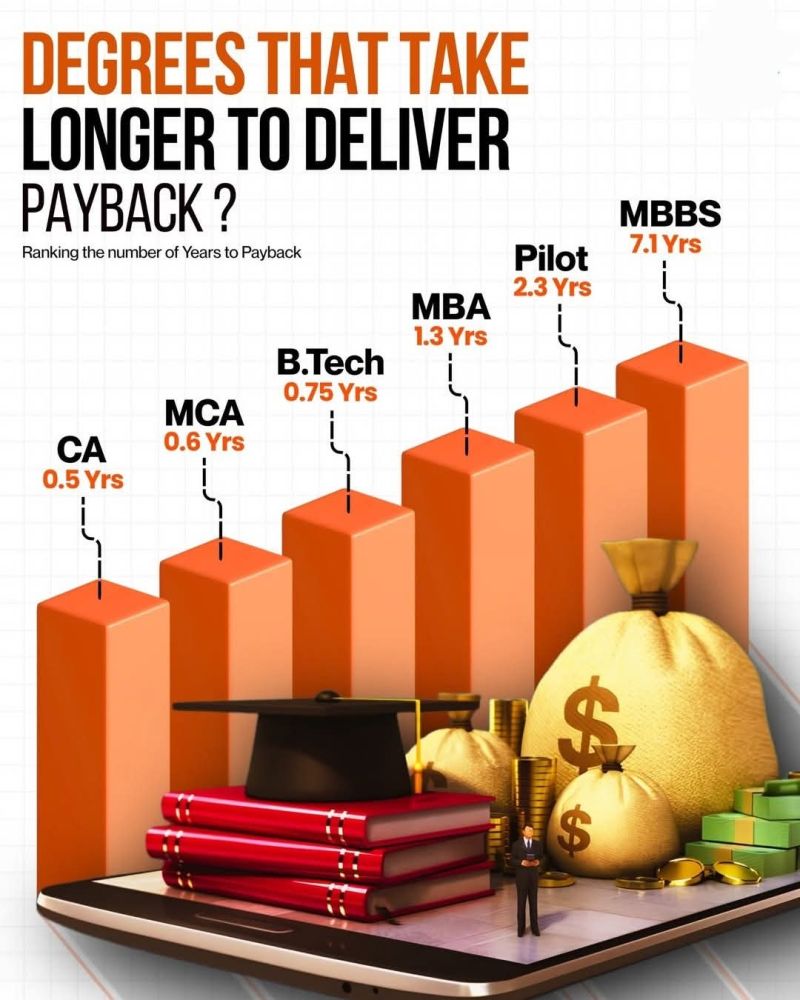
Now we can compare payback periods (Return on Investment – ROI) of different degrees in India, highlighting how long it takes to recover education costs after starting work. Key Insights of compares payback periods (Return on Investment- ROI) of different degrees in India
- Fastest ROI:
- Chartered Accountant (0.5 yrs) – Lowest cost + articleship earnings → quickest break-even
- MCA (0.6 yrs) and B.Tech (0.75 yrs) – Strong job market ensures quick recovery
- Moderate ROI:
- MBA (1.3 yrs)—High fees but decent salary growth helps recover costs in a little over a year
- Long ROI:
- Commercial Pilot (2.3 yrs) – High training costs delay recovery
- MBBS (7.1 yrs) – Very high fees + long study duration → slowest payback
Conclusion: Core Takeaways:
Choose a chartered accountant if you wish to build a career in Indian taxation, audit, corporate law, insolvency, and regulatory compliance. Choose Certified Public Accountant if your career goals involve US accounting standards, multinational corporations, global finance, or working in the United States. Many professionals today pursue both qualifications to enhance their global career opportunities.
- Low-cost, high-demand courses (like Chartered Accountant) deliver the best Return on Investment
- High-investment and long-duration courses significantly delay financial break-even
- Choosing a career should consider payback period, not just salary or prestige
- Education return on investment varies widely—a chartered accountant stands out as the most cost-efficient path, while MBBS has the longest financial recovery timeline.