Categories: Income TaxOthers

ALL ABOUT STATEMENT OF FINANCIAL TRANSACTION

Section 285BA—Statement of Financial Transactions (SFT)

The Statement of Financial Transactions (SFT) is a document or report that provides a comprehensive overview of an entity’s financial transactions over a specific period. It is a critical component of financial reporting and is typically prepared by businesses, organizations, and government agencies to accurately depict their financial activities and position.

Section 285BA requires specified persons to report high‑value financial transactions or registered financial activities to the Income Tax Department. The objective is to strengthen the Annual Information Statement (AIS) and ensure better tax compliance. Entities covered include banks (including co‑operative banks), post offices, companies issuing shares or debentures, NBFCs, registrars/sub-registrars, Mutual fund houses and Any other persons notified. The section ensures that transactions reflecting potential taxable events are captured through an institutional reporting mechanism.

Rule 114E—SFT Reporting Framework

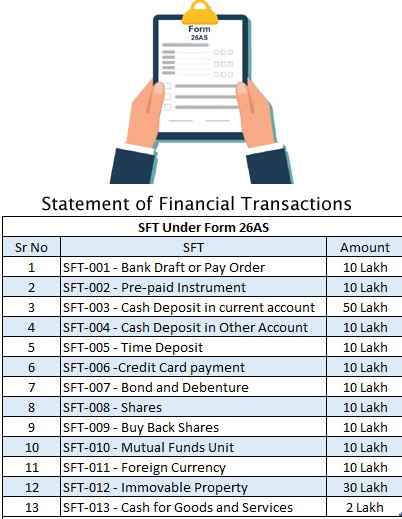
Income-tax Rules, 1962 : Rule 114E prescribes Which transactions must be reported, threshold limits, reporting format (Form 61A), and due date of filing (generally 31 May following the financial year). Following are reportable transactions under SFT—key thresholds. Below is a thematic summary of major SFT categories and limits:

Cash Transactions with Banks

A. Cash Deposits/Withdrawals

Account Type Threshold
Current Accounts Cash deposits or withdrawals exceeding INR 50 lakh in a FY
Savings Accounts Cash deposits exceeding INR 10 lakh in a FY

Co‑operative banks are fully covered.

Fixed Deposits

  • Reporting is required where a person invests INR 10 lakh or more in one or more term deposits (other than renewals).
  • Includes deposits with banks, post offices, and co‑operative banks.

Immovable Property Transactions

  • Purchase or sale of immovable property valued at ₹30 lakh or more must be reported.
  • Reporting responsibility lies with the Registrar/Sub‑Registrar, irrespective of stamp duty value disputes.

Credit Card Payments

Mode of Payment Threshold
Total annual payments More than INR 10 lakh
Cash payments More than INR 2 lakh

All banks and credit card issuers are required to file SFT for these cases.

Securities and Mutual Fund Investments

Reporting is required when a person acquires shares, debentures, or bonds or invests in mutual fund units amounting to ₹10 lakh or more in a financial year. This ensures visibility of large capital market investments. Reporting entities  the indicative list includes banks (public, private, and co‑operative), post offices, companies issuing securities, NBFCs, mutual fund houses, sub‑registrars, and credit card issuing institutions. These institutions collectively provide financial footprints of taxpayers, enabling a complete AIS profile.

Purpose of SFT Reporting

The SFT mechanism supports detection of undisclosed income, high‑value transaction tracking, cross-verification of AIS/TIS entries, and better risk evaluation for compliance enforcement. It is an integral part of the government’s financial transparency and anti‑evasion ecosystem.

IS THE FILING OF A NIL STATEMENT OF FINANCIAL TRANSACTIONS COMPULSORY?

  1. In case there is no reportable transaction, no statement of financial transactions (i.e., Form No. 61A) is required to be filed. The Tax Dept Reporting Entity Identification Number (ITDREIN) is compulsory only if there are any reportable transactions. No Tax Dept Reporting Entity Identification Number is needed if there is no transaction.
  2. A new simple functionality titled “Statement of Financial Transactions Preliminary Response” has been provided at the e-Filing portal for the reporting persons to indicate that a prescribed transaction type is not reportable for the FY.
  3. It is advisable to file a “statement of financial transactions preliminary response” even if there is no reportable transaction.
  4. CBDT has issued a press release dated 26/05/2017 aptly clarifying that registration of the reporting person (ITDREIN registration) is Compulsory only when at least one of the transaction types is reportable & not otherwise.

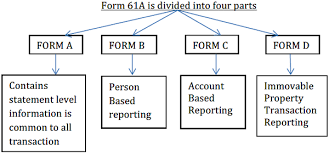
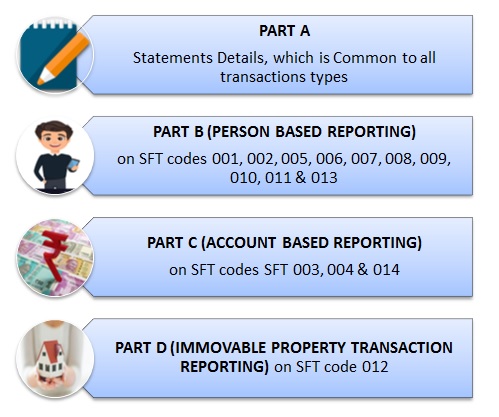
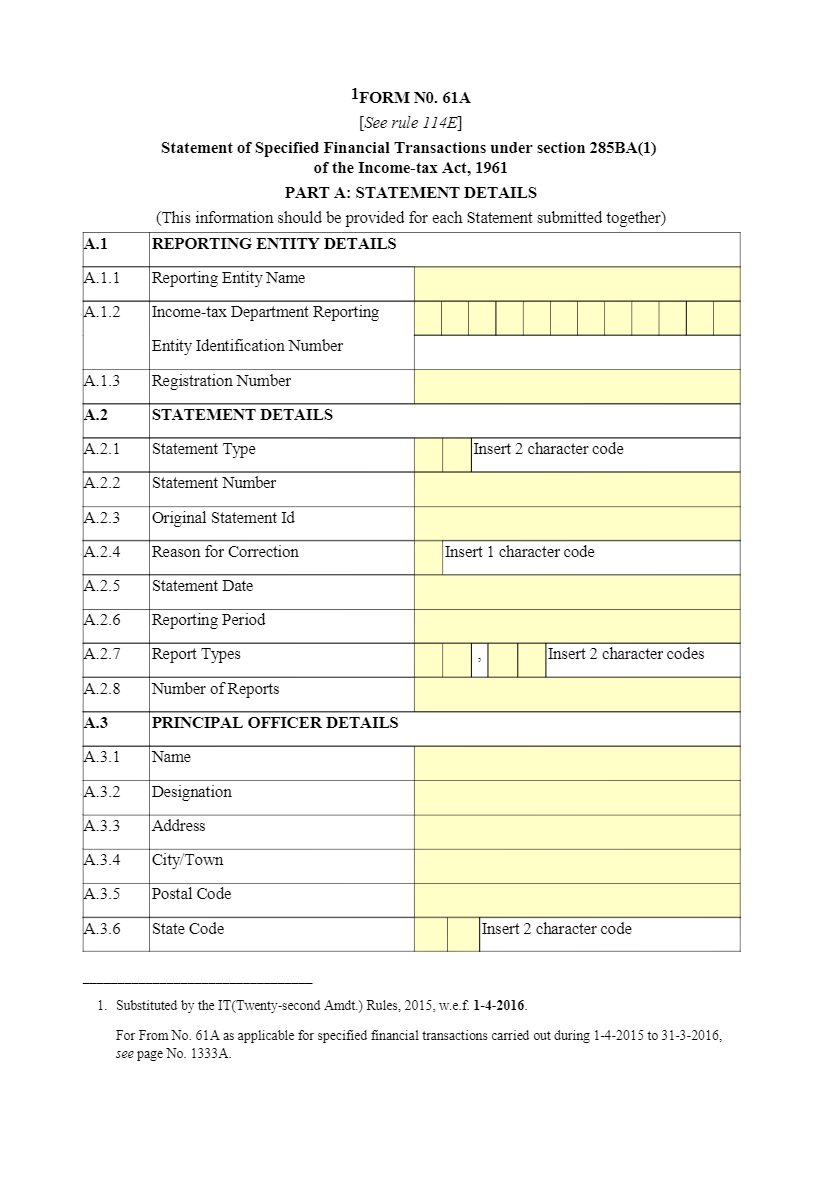
PARTS OF FORM 61A


SFT Filling Date Due Date:

The statement of financial transactions shall electronically be submitted in relation to an FY by the reporting entity with a DSC of the person responsible for verifying the declaration in Form No. 61A. The statement of financial transactions shall be submitted instantly after the FY in which the transaction is registered or registered on or before 31 May.

Failure to furnish SFT

In case of non-furnishing of the statement of financial transactions within the due date, Total, a penalty of Rs 500/- per day from the expiry of the original due date till the due date mentioned in the notice and Rs 1,000 per day beyond the due date specified in the notice. (Reference from Section 271FA of the Act)

The penalty of Rs 50,000 will be levied on the prescribed reporting financial institution if it provides inaccurate information in the statement where:

  • The person discovers the inaccuracy after the statement of financial transaction or reportable account is furnished and fails to inform and furnish correct information within 10 days. Or
  • the person knows of the inaccuracy at the time of furnishing the statement of financial transaction or reportable account, but does not inform the specified Tax authority or any other authority or agency; or
  • inaccuracy is due to a failure to comply with specified due diligence needed or is deliberate on the part of that person; or {as per provision of section 271FAA of Income Tax Act,}

In summary, the Statement of Financial Transactions serves as a vital tool for communicating an entity’s financial performance, position, and cash flows to stakeholders, facilitating informed decision-making and ensuring accountability and transparency in financial reporting. We look forward to your valuable comment.

ITR 1,2 & 4 for AY 2024-25 are now available on income tax portal for filing.

Tax Dept Releases E-Flyer: Say No to Understand Cash Transaction & its Limits for FY 2023-24

Income Tax E-Flyer on Maintenance of Books of Accounts

Popular Article :More read for related blogs are:

Contact Us

You may find us via email at singh@carajput.com or by phone at +91 9555 555 480, You can contact our NRI consultant in India or NRI ITR filing services in India. We also offer income tax compliance & registration services!

Rajput Jain & Associates

Rajput Jain & Associates is a Chartered Accountants firm, with it's headquarter situated at New Delhi (the capital of India). The firm has been set up by a group of young, enthusiastic, highly skilled and motivated professionals who have taken experience from top consulting firms and are extensively experienced in their chosen fields has providing a wide array of Accounting, Auditing, Taxation, Assurance and Business advisory services to various clients and their stakeholders. Rajput jain & Associates, a professional firm, offers its clients a full range of services, To serve better and to bring bucket of services under one roof, the firm has merged with it various Chartered Accountancy firms pioneer in diversified fields. We have associates all over India in big cities. All our offices are well equipped with latest technological support with updated reference materials. We have a large team of professionals other than our Core Team members to meet the requirements of our prospective clients including the existing ones. However, considering our commitment towards high quality services to our clients, our team keeps on growing with more and more associates having strong professional background with good exposure in the related areas of responsibility.

Recent Posts

GST on Event Entry Tickets – recreational/ cultural/sport

All about GST on event entry tickets—recreational, cultural & sporting services Meaning of Recreational, Cultural & Sporting Services (SAC 9996)… Read More

8 hours ago

Recent Amendments to FIU‑IND Regulations

Recent Amendments to FIU‑IND Regulations: What Businesses Need to Know Why the Amendments Were Introduced With the rapid rise of… Read More

1 day ago

Overview FIU- IND Unit – India registration in 2026

All about Financial Intelligence Unit – India registration in 2026 With rising scrutiny over digital assets, cross‑border payments, and fintech… Read More

5 days ago

TDS & TCS Changes in Budget 2026

TDS & TCS Changes (Effective from 1 April 2026): Budget 2026 The Indian Financial Budget 2026 introduces a major overhaul… Read More

1 week ago

Overview of Applicability of clarification of DSC

What is a Digital Signature Certificate (DSC)?  A Digital Signature Certificate (DSC) is an electronic form of identity proof, similar… Read More

1 week ago

Overview on Stock Transfer vs Supply under GST

Comparison Matrix: Stock Transfer vs. Branch Transfer under GST A Technical Analysis for Multi-Registration Businesses GST fundamentally changed the tax… Read More

2 weeks ago
Call Us Enquire Now