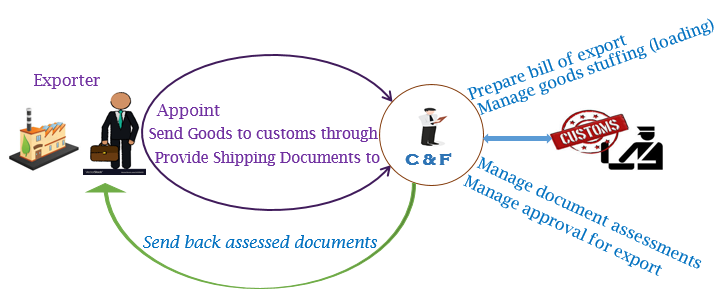
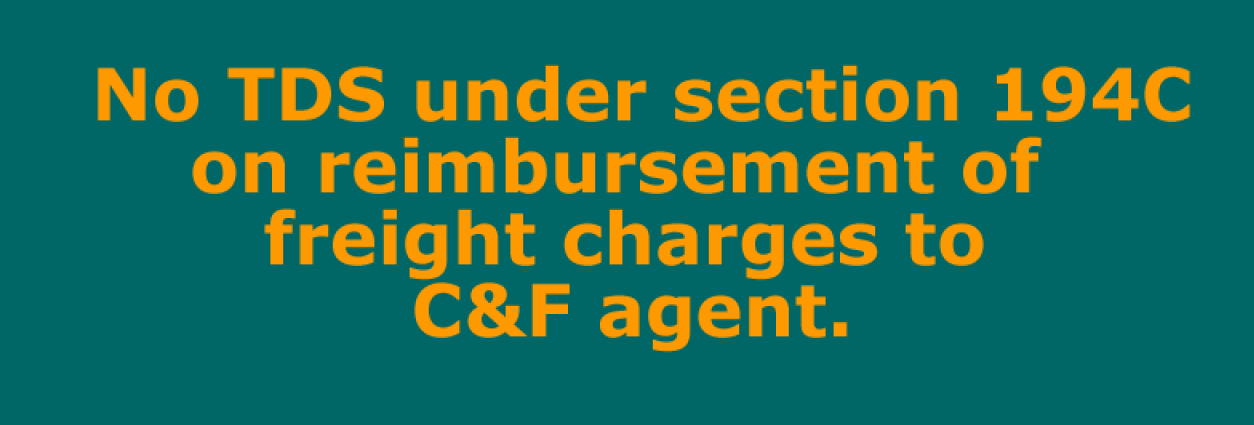
The issue is whether the payments to C&F agents that are entirely recovered for freight charges which have no element of gain are liable in compliance with Section 194C of the Income-tax Act to deduct TDS?
The basic questions of law that have been arising in this appeals are as below:-
(1) Whether on the facts and in the situations of the case, Court was right in law in holding that the Appellant is liable to deduct TDS u/s 194C of Income-tax Act 1961 on the payments made to Clearing and forwarding agents which is outright reimbursement of freight charges having no element of profit?
(2) Whether on the facts and in the situations of the case, Court was right in law in upholding the disallowance u/s 40(a)(ia) of Income-tax Act 1961 when said section cannot be applied in the instant case?
Below are the overviews of the High Court Order/judgment on the above Case:
More read for related blogs are:
Following material on record which found and establishes the below situation: –
(i) The Clearing and forwarding agents have raised 2 separate bills:
(a) 1st towards the services rendered by the Clearing and forwarding agents; and
(b) 2nd towards reimbursement of freight charges paid to the carriers.
(ii) These are not cases where any composite bills were raised by the Clearing and forwarding agents without indicating the reimbursement components & service charge components separately.
(iii) There are ample evidence in the form of bills, payment vouchers, ledger entries, etc., placed on record to settled that separate bills were invariably made towards the reimbursement components & service charge components by the Assessees to the Clearing and forwarding agents;
(iv) The Assessees have invariably deducted tax at source when it comes to payment towards the first set of bills i.e. towards the services rendered by the Clearing and forwarding agents without any demur;
(v) Even in cases where composite bills were issued or where there was any ambiguity about payment towards reimbursement components, the Assessees have TDS deducted;
(vi) It is only in cases where separate bills were raised by the Clearing and forwarding agents towards freight charges and reimbursement backed by proper evidence that the Assessees have not TDS deducted before making payments towards such reimbursement.
However, they also agree that this question will be required to be answered only if the substantial question of law (2) above is answered in favour of the Revenue and against the Assessee.
This means that only if we hold that the disallowance under Section 40(a)(ia) of the IT Act was valid in the facts and circumstances of the if a violation of TDS provision in the present case,
Conclusion
One Deadline Relaxed, Another Tightened: Four Key IBBI Circulars Every Insolvency Professional Must Know The Insolvency and Bankruptcy Board of… Read More
Direct Tax Collections FY 2026-27 (as on 14.10.2026) – Detailed Analysis The data compares Direct Tax collections up to 14… Read More
Key Provisions, Jurisdiction, Mediation under Commercial Courts Act 2015 Introduction The Commercial Courts Act, 2015 marked a significant reform in… Read More
GST Council Proposes Major Measures to Simplify Compliance The GST Council has recommended a series of reforms aimed at reducing… Read More
XBRL Applicability under the Companies Act, 2013 – Detailed Explanation XBRL (eXtensible Business Reporting Language) is a globally accepted electronic… Read More
MSME New Feature Alert: PAN to MSME Search in Bridze MSME Compliance Suite The PAN to MSME Search feature in… Read More