Page Contents
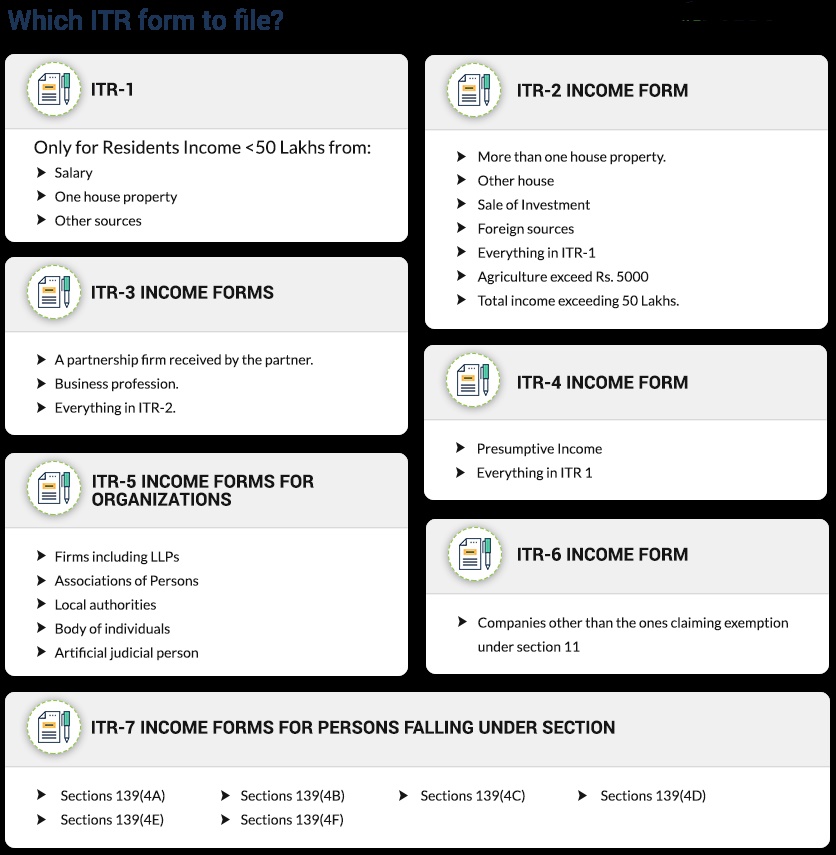
| ITR Form | Who Should File? |
|---|---|
| ITR-1 (Sahaj) | Resident individuals (other than not ordinarily resident) having total income up to ₹50 lakh from salary, pension, up to two house properties, other sources, and agricultural income up to ₹5,000. Also applicable where LTCG under Section 112A does not exceed ₹1.25 lakh. Not available to directors in companies or persons holding unlisted equity shares. ITR-1 (Sahaj) is meant for small and salaried taxpayers with simple sources of income. |
| ITR-2 | Individuals and HUFs having income from salary, multiple house properties, capital gains, foreign assets, foreign income, or agricultural income exceeding ₹5,000, but not having income from business or profession. ITR-2 is suitable for individuals earning capital gains, foreign income, or holding foreign assets, but not having business income. |
| ITR-3 | Individuals and HUFs earning income from business or profession, including proprietors, freelancers, consultants, and partners in partnership firms receiving remuneration or interest from the firm. ITR-3 is mandatory for individuals and HUFs engaged in business or professional activities, including partners receiving remuneration or interest from firms. |
ITR-4 (Sugam) |
Resident individuals, HUFs, and firms (other than LLPs) with total income up to ₹50 lakh opting for presumptive taxation under Sections 44AD, 44ADA, or 44AE. Also permitted for LTCG under Section 112A up to ₹1.25 lakh, subject to prescribed conditions. ITR-4 (Sugam) is designed for taxpayers opting for the presumptive taxation schemes under Sections 44AD, 44ADA, or 44AE. |
| ITR-5 | Partnership firms, LLPs, Associations of Persons (AOPs), Body of Individuals (BOIs), Artificial Juridical Persons (AJPs), and other entities not required to file ITR-7. ITR-5 is generally used by partnership firms, LLPs, AOPs, and BOIs. |
| ITR-6 | Companies other than those claiming exemption under Section 11 relating to income from property held for charitable or religious purposes. ITR-6 applies to companies that do not claim exemption under Section 11 of the Income-tax Act. |
| ITR-7 | Persons and entities required to furnish returns under Sections 139(4A), 139(4B), 139(4C), or 139(4D), including charitable trusts, religious trusts, political parties, research associations, educational institutions, and certain other exempt organizations. ITR-7 is prescribed for charitable trusts, religious institutions, political parties, educational institutions, and other entities required to file returns under special provisions. |
It is to be filed by persons having income from a business or profession. Thus, the eligible source of income for ITR 3 are –
Selecting the correct Income Tax Return (ITR) form is crucial for accurate compliance. The applicability of each form depends on the taxpayer’s status and the nature of income earned during the financial year.
| ITR Form | Applicable To | Salary Income | House Property | Business Income | Capital Gains | Other Sources | Exempt Income | Lottery / Race Horse Income | Foreign Assets / Income | Carry Forward of Losses |
|---|---|---|---|---|---|---|---|---|---|---|
| ITR-1 (Sahaj) | Resident Individuals and HUFs meeting prescribed conditions | ✔️ | ✔️ (Up to 2 House Properties) | NO | ✔️ (LTCG under Section 112A up to ₹1.25 lakh) | ✔️ | ✔️ (Agricultural Income up to ₹5,000) | NO | NO | NO |
| ITR-2 | Individuals and HUFs not having business or professional income | ✔️ | ✔️ | NO | ✔️ | ✔️ | ✔️ | ✔️ | ✔️ | ✔️ |
ITR-3 | Individuals and HUFs having business or professional income, including partners in firms | ✔️ | ✔️ | ✔️ | ✔️ | ✔️ | ✔️ | ✔️ | ✔️ | ✔️ |
| ITR-4 (Sugam) | Individuals, HUFs and Firms (other than LLPs) opting for presumptive taxation | ✔️ | ✔️ (Up to 2 House Properties) | ✔️ (Presumptive Scheme) | ✔️ (LTCG under Section 112A up to ₹1.25 lakh) | ✔️ | ✔️ (Agricultural Income up to ₹5,000) | NO | NO | NO |
| ITR-5 | Firms, LLPs, AOPs, BOIs, Artificial Juridical Persons and certain Trusts | NO | ✔️ | ✔️ | ✔️ | ✔️ | ✔️ | ✔️ | ✔️ | ✔️ |
| ITR-6 | Companies other than those claiming exemption under Section 11 | NO | ✔️ | ✔️ | ✔️ | ✔️ | ✔️ | ✔️ | ✔️ | ✔️ |
| ITR-7 | Trusts, Charitable Institutions, Political Parties, Research Associations and other entities required to file under specified provisions | NO | ✔️ | ✔️ | ✔️ | ✔️ | ✔️ | ✔️ | ✔️ | ✔️ |
The Union Budget 2026 has introduced several taxpayer-friendly measures aimed at providing greater flexibility in return filing and improving voluntary tax compliance. These changes give taxpayers additional time to correct errors in their returns while also rationalizing filing deadlines for different categories of assessees.
One of the most significant changes is the extension of the deadline for filing a revised income tax return (ITR).
This additional three-month window allows taxpayers more time to identify and correct omissions, reporting errors, incorrect disclosures, or missed income before the revision period expires.
Example: For FY 2025-26 (AY 2026-27), a taxpayer who files the original return in July 2026 can now revise it up to 31 March 2027, instead of being restricted to 31 December 2026.
To encourage timely compliance while still providing flexibility, the Government has proposed a nominal fee for filing revisions after the original due date.
This means Taxpayers can still rectify mistakes. A small additional charge may apply if the revision is made beyond the prescribed filing deadline, and the provision seeks to balance taxpayer convenience with administrative efficiency.
Budget 2026 has also clarified and streamlined due dates for various categories of taxpayers. following are ITR Filing Calendar:
| Category of Taxpayer | Due Date |
|---|---|
| ITR-1 and ITR-2 Filers (Individuals and HUFs not requiring audit) | 31 July |
| Non-Audit Business Cases and Trusts | 31 August |
| Audit Cases (Business, Profession and Trusts) | 31 October |
| Transfer Pricing Cases | 30 November |
| If You Are… | ITR Form |
|---|---|
| Salaried employee with income up to INR 50 lakh | ITR-1 |
| Salaried employee with capital gains or foreign assets | ITR-2 |
| Freelancer, consultant, professional, or proprietor | ITR-3 |
| Presumptive taxation taxpayer under Sections 44AD/44ADA/44AE | ITR-4 |
| Partnership Firm or LLP | ITR-5 |
| Company | ITR-6 |
| Trust, NGO, Educational Institution, Political Party | ITR-7 |
Popular Article :
GST Council Proposes Major Measures to Simplify Compliance The GST Council has recommended a series of reforms aimed at reducing… Read More
XBRL Applicability under the Companies Act, 2013 – Detailed Explanation XBRL (eXtensible Business Reporting Language) is a globally accepted electronic… Read More
MSME New Feature Alert: PAN to MSME Search in Bridze MSME Compliance Suite The PAN to MSME Search feature in… Read More
key recommendations of the 57th GST Council Meeting held on 8 October 2026. The 57th GST Council recommendations indicate a… Read More
GST on Charitable and Religious Trusts: Exemptions, Rulings and Compliance Explained Do charitable trusts pay GST? The short answer Yes.… Read More
GST Multi-State Registration Made Simer: One Master TRN for Multiple States Expanding a business into new States has always come… Read More