PROCESS FOR NEW BUSINESS REGISTRATIONS & DOCUMENTS REQUIREMENT FOR GST REGISTRATION IN DELHI/INDIA.
WHO ARE LIABLE TO BE REGISTERED?
Following categories of suppliers shall mandatory required to get registered under this Act irrespective of the threshold limit:*
Persons who supply goods and/or services, other than branded services, through electronic commerce operator.
LIABILITY FOR REGISTRATION IN GST
| Region | Aggregate Turnover |
| North East India + Sikkim, J&K, Himachal Pradesh and Uttarakhand | Rs 10 Lakhs |
| Rest of India | Rs 20 Lakhs |
GST REGISTRATION FORMS FOR OTHER STAKEHOLDERS
| Form No. | Form Type |
| Form GST REG-07 | Application for Registration as Tax Deductor or Tax Collector at Source |
| Form GST REG-08 | Order of Cancellation of Application for Registration as Tax Deductor or Tax Collector at Source |
| Form GST REG-09 | Application for Allotment of Unique ID to UN Bodies/Embassies |
| Form GST REG-10 | Application for Registration for Non Resident Taxable Person |
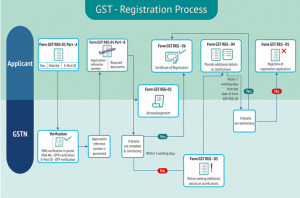
GST REGISTRATION PROCESS IN INDIA
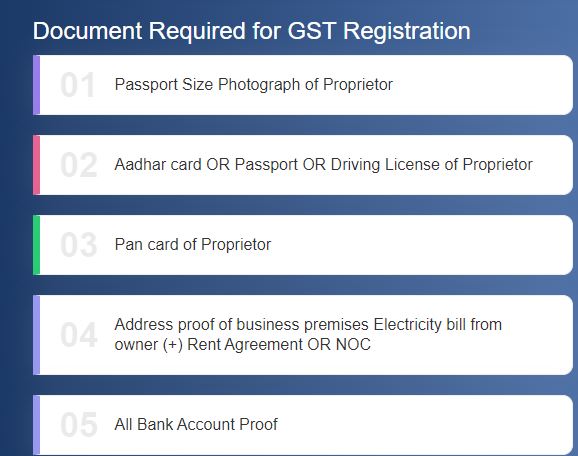
GST REGISTRATION IN DELHI: GST registration is on for DVAT Dealers from 16 December to 31st December 2016. Documents Required For GST Registration:
All documents to be scanned and uploaded at www.gst.gov.in in the format.
If you are a regular dealer or a composite tax payer, you need to do the following for GST registration:
If the details submitted are not satisfactory, the registration application is rejected using Form GST REG-05.
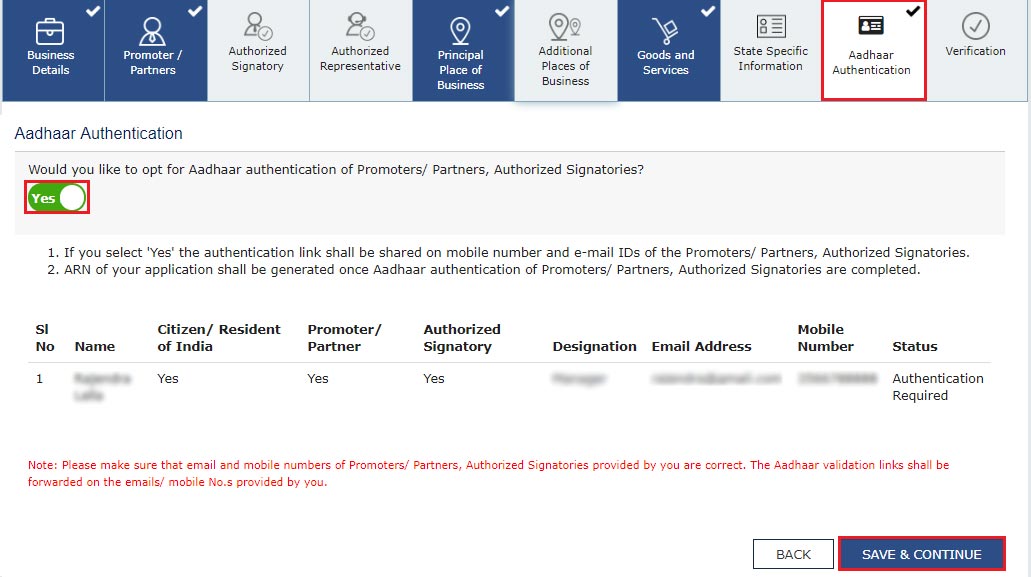
You must all observe the Aadhar Authentication text verification code as and when you log in to your GST Profile. Here’s what needs to be done;
Functionality for Aadhaar Authentication and e-KYC where Aadhaar is not obtainable has been deployed to GST Common Portal w.e.f. 6 January 2021 for existing taxpayers. All taxpayers registered as Regular Taxpayers (such as Casual Taxable Person, SEZ Units/Developers), ISD and Composition Taxpayers may submit their Aadhaar Authentication or e-KYC to the GST Portal. This shall not apply to government departments, public sector, local authorities and statutory authorities.
What is Aadhaar Authentication or an e-KYC?
If Aadhaar is available, the mainly Authorized signatory and one person who is Managing Partner/Director / Karta of the entity registered/ Proprietor/Partner can go for the Aadhaar Authentication.
Lack of availability of Aadhaar, You can submit any of the below documents to undergo e-KYC:
How to make e-KYC on Portal/ Aadhar Authentication
Note: in case the same person is Primary Authorized Signatory & Promoter/ Partner, Aadhaar authentication is only needed to be done for that person.
You would refer below link of the tutorial in case any further clarification is needed;
https://tutorial.gst.gov.in/userguide/registration/index.htm#t=manual_aadhaar.htm
Recommendation/Comments
As per section 25(6A) as per income tax act 1961, which deals with Aadhaar Authentication of existing registered persons states that the Aadhaar Authentication will be done in such form & manner, within such time as may be specified. But, No corresponding amendment/ notification in rules has been carried out. The Govt has straightaway gone to implement the same through the GSTN portal.
However, it is recommended that we needed to undertake the Aadhaar Authentication.
FOR FURTHER QUERIES CONTACT US:
W: www.carajput.com E: singh@carajput.com T: 9-555-555-460
GST on Charitable and Religious Trusts: Exemptions, Rulings and Compliance Explained Do charitable trusts pay GST? The short answer Yes.… Read More
GST Multi-State Registration Made Simer: One Master TRN for Multiple States Expanding a business into new States has always come… Read More
New TDS Framework for Purchase of Property from NRIs Effective 1 October 2026 Income Tax Notification: The CBDT has notified… Read More
Statutory Tax Compliance Calendar – October 2026 October 2026 is one of the busiest compliance months of the year. Businesses… Read More
Unpaid Audit Fees and Auditor Independence: What the ICAI Code of Ethics Really Says No, an auditor is not barred… Read More
Moving to the UAE: What Actually Decides Your Indian Tax Residence Documents show where you live, not your tax status… Read More