Page Contents
www.carajput.com; GST RETURN- GST Rule 86B
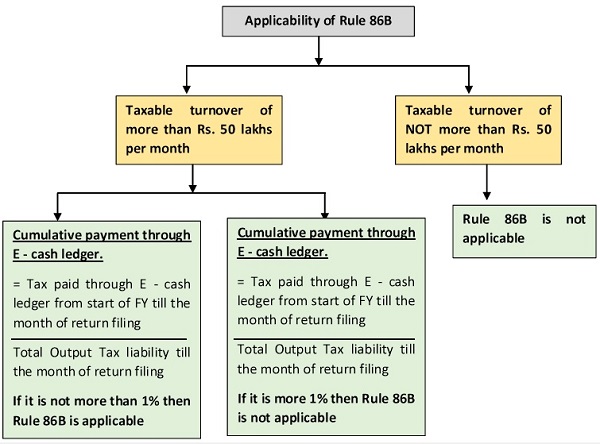
A new rule in CGST rules 2017 has been declared by the Central Government; rule 86B provides restrictions on the use of Input Tax Credit to release output liabilities. This regulation extends from 1 January 2021 onwards and has an overriding effect on other laws. It ensures that the registered individual cannot use the amount available in the credit ledger to pay the output tax liability in excess of 90% of that tax liability. If the amount of the taxable supply exceeds the exempted supply and the zero-rated supply, it exceeds 50 lakh rupees per month.
By avoiding the cascading impact of taxes, the ITC plays an important role in the GST. There have been several improvements in the order of use of ITC for various components such as CGST, SGST and IGST. However, to release the output tax liability, the ITC available in the electronic credit ledger can be fully utilized. The use of the ITC balance for payment of its production tax liability has been limited by new rule 86B.
Rule 86B restricts the use of the open ITC in the electronic credit ledger for the release of the liability for output tax. This rule has a negligible effect on all the other CGST laws.
This rule extends to registered persons with a taxable supply value greater than Rs.50 lakh per month. Before filing each return, the limit has to be reviewed every month.
On ITC, applicable registered individuals will not be responsible for more than 99% of the production tax liability. In other words, by using the input tax credit, more than % of the production tax liability cannot be released.
CBIC has, however, explained that 1% of tax liability is often unveiled for which refund is not permitted. The new law includes numerous exceptions such as exporters, inverted tariff structure suppliers, and taxpayers whose footprint is in the database on income tax.
A new amendment & several changes have been introduced under the GST plan via the 14th GST amendment rules 2020. The blog focuses on the essential rule added with regard to the ITC that will be implemented on 1/01/2021.
This latest rule has been implemented in 86B which shows that at least 1 percent of their output GST liability in cash is the division of the assessee to mandate discharge. Fake people are seeking to discharge the Complete GST liability through an Income Tax credit so avoiding cash payments. The fraudster can be tracked via this limit. Which has been Founded by lawmakers just because of the increase in daily fake invoicing spam. In this way, it would ensure the verification of unfaithful acts and the disclosure of revenue inside the Govt’s safe.
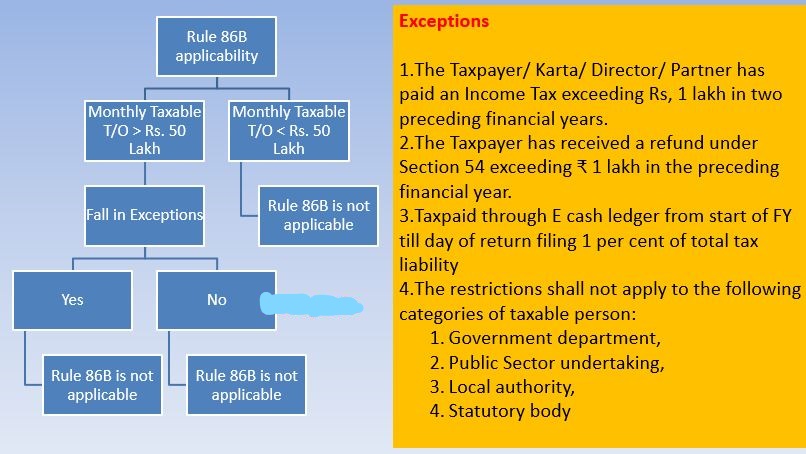
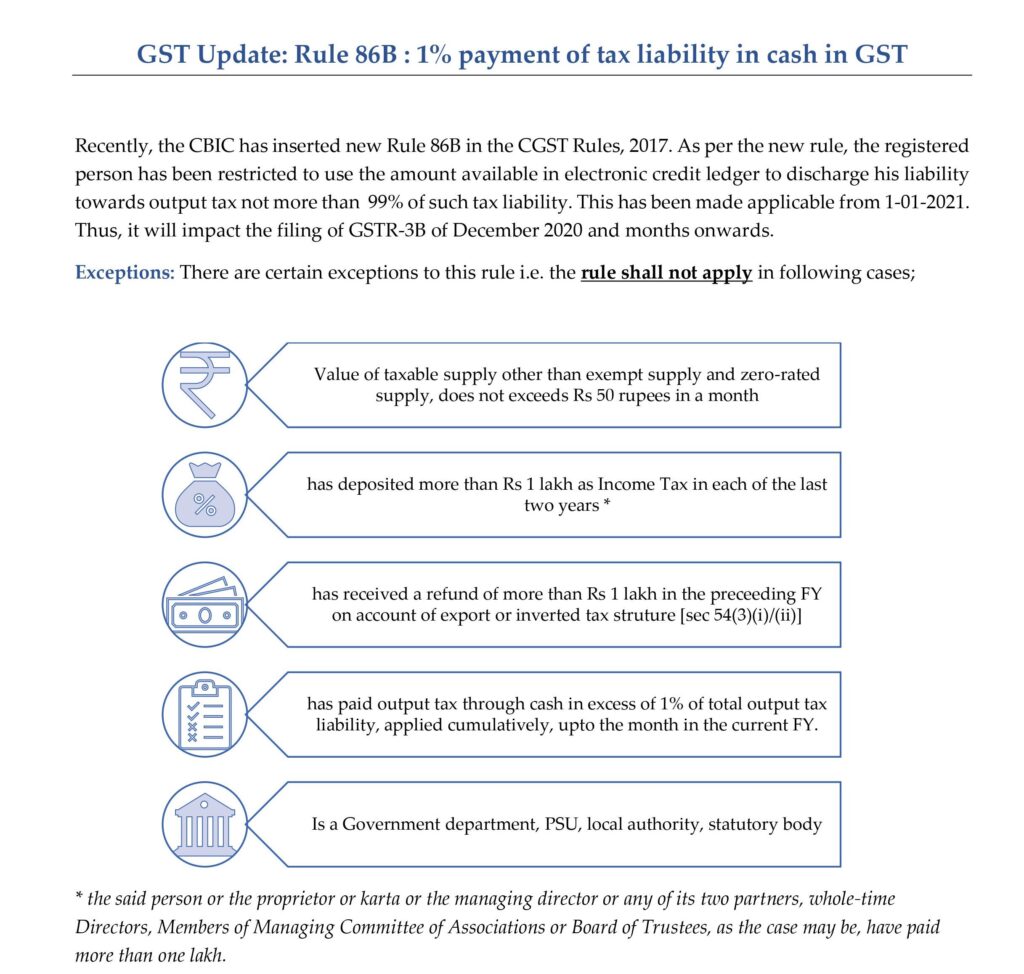
As a consequence of this required obligation to release Goods & Services Tax liabilities of no less than 1 Percent it is more difficult through cash during the Covid -19 lockdown period, below are the mentioned compliances for these procurements, which provide a different viewpoint. The amount of the taxable supply (Excluding exempt & Zero-rated) is less than INR 50,00,000/- Per month. As a result, smaller assessees will not include in this assent. The assessee or principal officers of him, such as MD, Full-time Director, etc., possess INR 1,00,000/- as income tax benefit under the Income Tax Act, 1961, in each of the last two Financial Years.
The fund that is not used shall be reimbursed by the assessee for those funds that are more than INR 1,00,000/- in the Past FY in respect of Zero Rated Supplies furnished, except any payment of tax or inverse duty structure. A Goods & Services Tax liability via the cash is paid by the assessee of 1 Percent of the output tax liability that is steadily being added to the tax period in the current FY. The Assessee is a Govt. Dept, a PSU, Municipal authority/statutory authority.
Key Provisions, Jurisdiction, Mediation under Commercial Courts Act 2015 Introduction The Commercial Courts Act, 2015 marked a significant reform in… Read More
GST Council Proposes Major Measures to Simplify Compliance The GST Council has recommended a series of reforms aimed at reducing… Read More
XBRL Applicability under the Companies Act, 2013 – Detailed Explanation XBRL (eXtensible Business Reporting Language) is a globally accepted electronic… Read More
MSME New Feature Alert: PAN to MSME Search in Bridze MSME Compliance Suite The PAN to MSME Search feature in… Read More
key recommendations of the 57th GST Council Meeting held on 8 October 2026. The 57th GST Council recommendations indicate a… Read More
GST on Charitable and Religious Trusts: Exemptions, Rulings and Compliance Explained Do charitable trusts pay GST? The short answer Yes.… Read More